What Does WinSleep Do?
WinSleep is a utility for the Windows operating system designed to optimize power consumption by ensuring computers remain in a sleep or hibernation state during periods of inactivity. The software allows users to specify time windows where the machine should stay asleep, provided system resource usage remains below certain thresholds. To facilitate this, the app provides real-time monitoring of CPU, disk, and network activity.
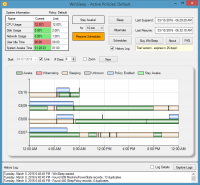
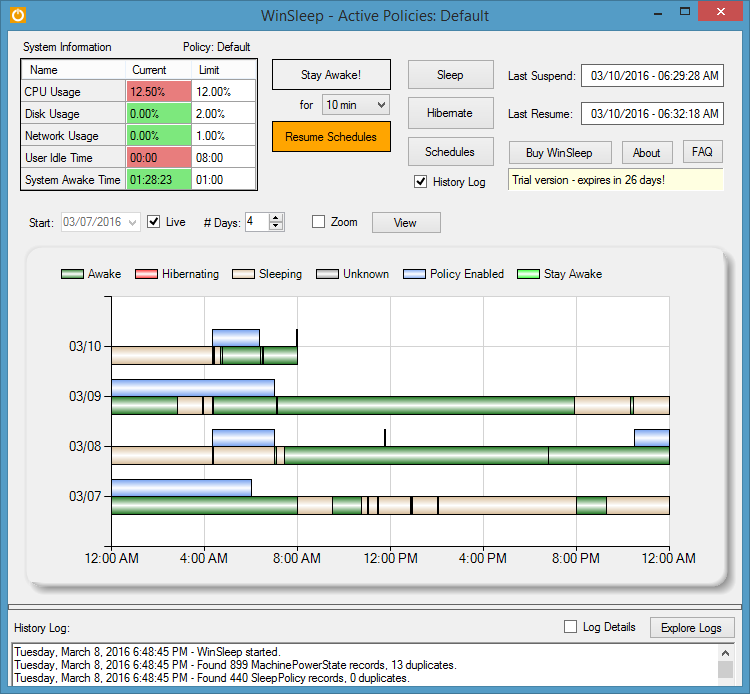
The interface features a detailed timeline graph that visualizes when the computer was awake, asleep, or hibernating. For users who prefer manual control, the utility includes dedicated Sleep and Hibernate buttons. By automating power states, the software addresses the high energy demands of desktop computers, which can consume approximately 250 watts when active. Reducing active time by half can result in estimated annual electricity savings of over $100 based on standard utility rates.
Additionally, WinSleep aids in extending the lifespan of internal hardware. When the computer is asleep, the motherboard is powered down, disk drives stop spinning, and cooling fans cease operation. This reduction in mechanical activity helps prevent dust accumulation and minimizes wear on internal components. The utility ensures that monitors enter standby mode effectively, further reducing total system draw and operational costs.
Top 5 Reasons To Download WinSleep
- Substantial Financial Savings: Dramatically reduce your electricity bill by ensuring your PC only draws power when it is actually being used.
- Intelligent Activity Monitoring: Unlike standard Windows timers, this tool keeps your PC awake based on actual CPU, disk, and network activity.
- Extended Hardware Longevity: Protect your investment by reducing mechanical wear and tear, heat exposure, and dust accumulation in your computer components.
- Visualized Power Management: Gain full transparency into your PC's behavior with detailed timeline graphs showing exactly when your machine was awake, asleep, or hibernating.
- Real-Time Performance Diagnostics: Monitor your system’s health with integrated displays for CPU, Disk, and Network usage percentages.
If you are like most computer users, your desktop or high-powered workstation is likely running far more often than it needs to be. We have all been there: you step away for a "quick break" that turns into an hour-long phone call, or you leave a download running overnight only to have the computer sit idle for six hours after the task is finished. Standard Windows power settings are notoriously finicky, often failing to put the computer to sleep when they should, or worse, putting the machine to sleep right in the middle of a critical background task. This is where WinSleep enters the frame as an essential utility for the modern tech enthusiast.
In this review, we are going to dive deep into why WinSleep is a must-have addition to your software library. It is not just a "utility"; it is a comprehensive management system for your hardware’s lifecycle and your personal finances. Let’s break down the top five reasons why you need to jump on this giveaway immediately.
1. Substantial Financial Savings
The first and most immediate reason to download WinSleep is the impact it will have on your wallet. We often think of our computers as small appliances, but a high-end desktop is anything but "small" when it comes to power consumption. A typical modern desktop computer can easily pull 250 watts of electricity while awake and idling. If you have a high-end gaming rig or a workstation with multiple monitors, that number can climb significantly higher. Even when you aren't actively gaming or editing video, those components are drawing a steady stream of power from your wall outlet.
Let’s look at the math, because the numbers are staggering when you see them laid out. In many parts of the United States and Europe, energy prices are rising. If we take a conservative estimate of 10 cents per kilowatt-hour (kWH), a 250-watt computer costs you 2.5 cents for every hour it stays awake. That might sound like pocket change, but let’s consider a common scenario: a computer that stays awake 24 hours a day because the user is afraid of losing their place or because the Windows "Auto-Sleep" feature failed to trigger. That is 60 cents a day, or roughly $18 a month, just to let a machine sit idle.
WinSleep changes the equation by ensuring that your computer sleeps for as much of the day as possible. If the software manages to keep your computer asleep for just half of the day while you are sleeping, working, or running errands, you are looking at a savings of over $100 per year. And remember, that calculation doesn't even include the power draw of your monitors! Most users have dual-monitor setups these days, and those screens are notorious power-hogs. By ensuring the system enters a true sleep state, WinSleep triggers the monitor's standby mode, further compounding your savings. Over the life of a single computer, this software could literally pay for a brand-new GPU or a massive SSD upgrade just through the money saved on your utility bill.
2. Intelligent Activity Monitoring
The biggest frustration with the built-in Windows power management is that it is "dumb." It relies almost entirely on a timer. If you haven't moved your mouse or touched your keyboard in 30 minutes, Windows tries to sleep. But what if you are rendering a video? What if you are downloading a 100GB game update? What if your Plex server is currently streaming a movie to your living room TV? Standard Windows sleep settings often ignore these background processes, leading to the computer falling asleep while it is actually doing work, or—conversely—staying awake forever because a single "zombie" process is tricking the OS into thinking the user is active.
WinSleep provides a much-needed injection of "intelligence" into this process. Instead of relying on a simple timer, WinSleep monitors actual system activity. It looks at CPU usage, disk input/output, and network traffic. You can specify thresholds that define what "busy" means to you. For example, you can tell WinSleep, "If my CPU usage is above 5%, do not go to sleep." This ensures that if you are running a complex calculation or a virus scan, the computer stays powered on until the job is done. Once the task finishes and the CPU usage drops below your specified limit, WinSleep realizes the machine is no longer "busy" and initiates the sleep sequence.
This level of granularity is a game-changer for anyone who uses their computer for more than just browsing the web. It eliminates the "anxiety of the sleep timer." You no longer have to disable sleep entirely when you start a long download, only to forget to turn it back on later. WinSleep acts as a vigilant guardian, keeping the lights on only as long as there is work to be done and turning them off the moment the room is empty. It’s the smart home equivalent for your desktop environment.
3. Visualized Power Management
Have you ever woken up in the morning, walked into your office, and found your computer fan spinning and the RGB lights glowing, even though you specifically remember putting it to sleep the night before? It’s a common frustration known as the "mystery wakeup." Somewhere in the middle of the night, a scheduled task, a Windows update, or a stray network packet woke your machine up, and it stayed awake for hours consuming power for no reason.
WinSleep solves this mystery by providing a beautiful, detailed timeline graph. This isn't just a log file; it is a visual representation of your computer’s life. The graph shows you exactly when the computer was Awake, when it was Asleep, and when it was in Hibernation. You can look back at the previous night and see, "Oh, at 3:00 AM, the computer woke up for twenty minutes and then went back to sleep."
This transparency is invaluable for troubleshooting. If you see that your computer is staying awake for hours during the night, you can cross-reference that time with your Windows Task Scheduler or your network logs to find the culprit. It gives the user a sense of control that is completely missing from the standard Windows experience. As a tech reviewer, I am a firm believer that data is power. Knowing exactly how your machine behaves when you aren't looking allows you to optimize its performance and its energy footprint. WinSleep turns your power management from a "black box" into an open book.
4. Extended Hardware Longevity
We often talk about the financial cost of electricity, but we rarely talk about the physical cost of "uptime." Every hour your computer is awake is an hour that its components are moving toward their eventual failure. Even though modern electronics are durable, they are still subject to the laws of physics. Fans have bearings that eventually wear out. Hard drives have spinning platters (if you're still using HDDs) or limited write cycles. Most importantly, heat is the enemy of all silicon components.
When your computer is awake, the motherboard is fully powered, the voltage regulators are working, and the cooling fans are spinning. These fans act like vacuum cleaners, constantly pulling air—and the dust that comes with it—into your computer casing. Over months and years, this dust accumulates on your heatsinks and components, leading to higher temperatures and potentially throttled performance or hardware failure. By using WinSleep to maximize the time your computer spends in a sleep state, you are effectively "pausing" the aging process of your hardware.
While the computer is asleep, the disk drives aren't spinning, the motherboard is in a low-power state, and the fans are completely off. This means no dust is being sucked in, and no heat is being generated. If you can increase your computer's sleep time from 4 hours a day to 14 hours a day, you are significantly extending the lifespan of your cooling system and your internal components. For anyone who has invested thousands of dollars into a custom-built PC, WinSleep is like an insurance policy that keeps your hardware running "like new" for a much longer period of time. You aren't just saving money on the electric bill; you are delaying the day you have to spend $1,500 on a replacement machine.
5. Real-Time Performance Diagnostics
Finally, WinSleep doubles as a lightweight system monitor. While its primary goal is power management, it provides convenient, real-time displays of your CPU, Disk, and Network usage percentages. This is incredibly handy for those of us who like to keep an eye on "what's going on under the hood" without having to keep the heavy Windows Task Manager open all the time.
The interface includes dedicated, easy-access buttons for Sleep and Hibernate. While Windows has these buttons hidden in the Start menu, having them front-and-center in a dedicated utility is surprisingly convenient. It encourages better habits. If you know you are leaving for lunch, one click on the WinSleep interface ensures the machine goes down exactly how you want it to. Combined with the real-time usage stats, you can see at a glance if it's "safe" to sleep. If you see your Network usage is at 50%, you know a download is still active, and you might want to wait. If everything is at 0% or 1%, you can hit that sleep button with confidence.
This combination of manual control and automatic intelligence makes WinSleep the ultimate "cockpit" for your computer's power state. It is rare to find a utility that is this lightweight while offering so much utility. It doesn't hog system resources (which would be counter-productive for a power-saving app!), and it sits quietly in the background doing its job until you need it.
The Final Verdict: If you value your hardware, your time, and your bank account, WinSleep is an absolute no-brainer. We live in an era where "green computing" is no longer just a buzzword; it's a necessity. Being able to reduce your carbon footprint while simultaneously saving over a hundred dollars a year is a win-win scenario that doesn't come around often. The timeline features and the intelligent activity thresholds elevate this from a simple "shutdown timer" to a sophisticated piece of system management software. Don't let your computer waste another watt of power—download this giveaway, set up your thresholds, and start saving today. Your hardware (and your wallet) will thank you.

Reviews for WinSleep
Click Here to Read Reviews for WinSleep >> Click Here to Submit Reviews for WinSleep >>