What Does Desktop Secret Lock 2 Do?
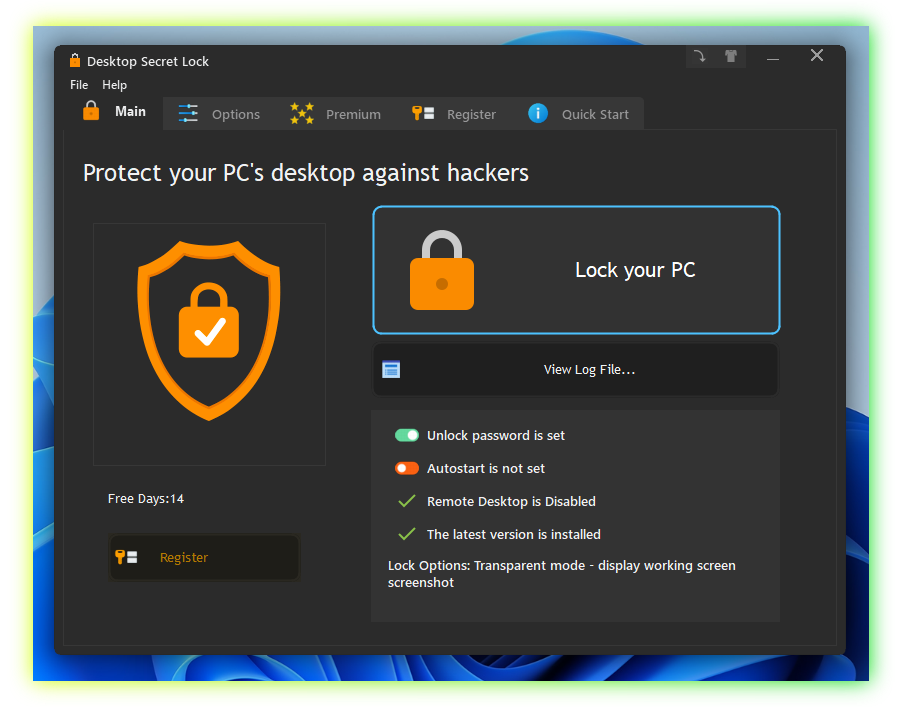
Desktop Secret Lock provides a specialized security layer designed to prevent unauthorized access to Windows PCs, both locally and via remote connections. Unlike standard system locks, this tool utilizes a transparent desktop lock, which allows the monitor to remain visible while disabling all user interaction. The software monitors and logs all attempts to access the machine, notifying the owner if there has been any keyboard or mouse activity during their absence.
The utility is specifically engineered to mitigate risks associated with common remote desktop software, including TeamViewer, AnyDesk, and Windows Remote Desktop. These platforms are frequent targets for brute-force attacks and credential exploitation. Desktop Secret Lock addresses these vulnerabilities by implementing a non-standard locking mechanism that functions independently of the Windows account credentials. This creates a secondary security perimeter that remains active even if the primary system password is compromised or bypassed.
Core features of the software include:
- Real-time Monitoring: The system detects and records unauthorized physical interactions with the PC hardware.
- Independent Authentication: Users set a unique password that stands separate from the operating system login.
- Secure Mode Operation: The software prevents access to the active working desktop even when the screen appears to be in an unlocked state.
- Remote Access Defense: It adds a barrier against hackers attempting to exploit vulnerabilities in remote control protocols.
By bypassing standard Windows API locking protocols, the software ensures that the desktop remains in a secure state, effectively neutralizing common methods used by intruders to gain control of a workstation.
Top 5 Reasons To Download Desktop Secret Lock 2
- Revolutionary Transparent Locking Technology: Keep an eye on your background tasks while maintaining a full security lockdown that prevents physical tampering.
- Hardened Defense Against Remote Access Vulnerabilities: Adds an essential secondary layer of protection for users of RDP, TeamViewer, and AnyDesk, thwarting brute-force attacks.
- Isolated Secondary Password Security: Utilize a unique password completely separate from your Windows login, ensuring that even a compromised system password won't grant access to your desktop.
- Real-Time Intrusion Awareness: Gain instant notification and logging the moment someone attempts to interact with your mouse or keyboard without authorization.
- Non-Standard Security Architecture: Move beyond the predictable Windows lock screen with a proprietary mechanism that evades standard exploit kits and bypass scripts.
In the modern age of digital vulnerability, we often think of "security" as a complex web of firewalls and antivirus subscriptions. But there is a glaring hole in most people’s security posture that is often overlooked: the physical and local access to the machine itself. Whether you are working in a busy open-plan office, living in a shared dorm, or managing a home office where curious kids or roommates might wander in, your PC is a goldmine of private data. Standard Windows security is a great baseline, but for those of us who take our privacy seriously, it is simply not enough. This is where Desktop Secret Lock steps in. As a tech reviewer who has seen hundreds of security utilities, I can tell you that this isn't just another gimmick; it’s a sophisticated rethink of how we protect our active workspaces. If you have the chance to grab this giveaway, you need to act fast. Here is why this software is a game-changer for your professional and personal PC security.
1. Revolutionary Transparent Locking Technology
The first thing that strikes you about Desktop Secret Lock is its "invisible" approach to security. Traditional locking methods involve a static screen—usually the Windows login page or a screensaver—that hides everything you are doing. While this works for privacy, it fails for productivity and monitoring. Imagine you are rendering a high-resolution video, downloading a massive dataset, or running a complex system scan. You want to walk away from your desk, but you also want to be able to glance at the monitor from across the room to see the progress bar. With standard locks, you have to log back in just to check the status.
Desktop Secret Lock changes the game by offering a transparent desktop lock. Your screen remains visible, but the input layer is completely frozen. This creates a "glass wall" effect. You can see your windows, your icons, and your progress bars, but the mouse and keyboard are effectively dead to anyone who doesn't have the secret password. This is incredibly useful for professionals who need to maintain "eyes-on" status for their workflows without leaving their systems vulnerable to a passerby clicking "cancel" on a three-hour render or snooping through an open browser tab. It provides the perfect balance between visibility and total lockout, ensuring that your workflow is never interrupted by unauthorized hands.
Furthermore, this transparency acts as a clever psychological deterrent. Most intruders are looking for a machine that is "open." When they see your desktop active, they might be tempted to move the mouse. The moment they do, the software engages its security protocols. It’s a proactive way to maintain your workspace while ensuring that your "digital territory" remains strictly off-limits to everyone but you.
2. Hardened Defense Against Remote Access Vulnerabilities
If you have ever used Windows Remote Desktop (RDP), TeamViewer, or AnyDesk, you are likely aware of how convenient they make our lives. However, from a security standpoint, they are often the "open windows" that hackers love to climb through. Remote access software is a prime target for brute-force attacks, where automated scripts try thousands of password combinations per second until they break in. Even worse, vulnerabilities in these programs are discovered frequently, allowing attackers to bypass standard login screens entirely.
Desktop Secret Lock acts as a "second gatekeeper" specifically designed to catch what your remote software might miss. Because this utility uses a non-standard locking method that operates independently of the Windows authentication service, a hacker who manages to spoof a Windows login or exploit an RDP bug will find themselves staring at a locked desktop they cannot interact with. They might have "connected" to the PC, but they are stuck behind the Secret Lock layer.
This is a critical distinction for anyone who leaves their computer on for remote access. By downloading this software, you are essentially adding a custom-built vault door inside your digital house. Even if a thief picks the lock on the front door (your remote software), they still can’t get into the vault where your actual files and active sessions are located. In an era where ransomware and data theft are at an all-time high, this extra layer of defense for remote users is not just a luxury—it is a necessity.
3. Isolated Secondary Password Security
We have all been taught that having a strong Windows password is the key to security. But let’s be honest: Windows passwords can be bypassed. There are numerous "password reset" tools and bootable Linux environment tricks that can clear a Windows user password in minutes. Additionally, if you use a Microsoft account to log in, your PC security is tied to your email security. If your email is compromised, your PC is effectively wide open.
Desktop Secret Lock solves this by implementing a completely isolated password system. When you set up the software, you create a unique password that is stored and encrypted separately from your Windows user credentials. This "Separation of Concerns" is a fundamental principle in high-level cybersecurity. Even if someone manages to find out your Windows login through a keylogger or shoulder-surfing, they still won't have the password needed to unlock the Secret Lock desktop layer.
This is particularly vital for those of us who use "Easy" passwords for Windows for the sake of convenience or use biometric login (like fingerprint or face ID) which can sometimes be tricked or forced. By having a secondary, dedicated password for your active desktop session, you are ensuring that your most sensitive environment—the one where your bank accounts are logged in and your private messages are open—is protected by a secret key that only exists within this specific application. It turns your PC into a two-factor authenticated fortress without the need for a physical dongle.
4. Real-Time Intrusion Awareness
One of the most frustrating things about traditional PC security is that you never know if someone *tried* to get in. If you come back to your computer and it’s at the login screen, you have no idea if a co-worker tried to guess your password ten times or if your cat just stepped on the keyboard. Knowledge is power, and Desktop Secret Lock gives you that power through real-time intrusion monitoring.
The software is designed to be incredibly sensitive to unauthorized interactions. The moment a mouse click is registered or a key is pressed while the system is in "Secret Lock" mode, the software flags it. This provides an immediate sense of security, as you can configure the system to notify you of these attempts. It takes away the "mystery" of what happens to your computer when you are in the other room or away at lunch.
Imagine the peace of mind knowing that your PC is actively "watching" itself. This feature is a massive benefit for professional environments where office politics or corporate espionage might be a concern. It’s also a great tool for parents who want to make sure their children aren't trying to access restricted content while the parent is away for a few minutes. Instead of wondering if your privacy was violated, you will have the definitive data to know exactly when and how someone tried to access your machine. It transforms your PC from a passive device into an active participant in its own protection.
5. Non-Standard Security Architecture
In the world of hacking, "standard" is the enemy. Hackers build tools to defeat the systems that the majority of people use. Because Windows is the most popular operating system in the world, its locking mechanisms, its kernel behaviors, and its login scripts are all thoroughly documented and targeted by malware authors. If a hacker knows how Windows locks a screen, they can develop a tool to "unlock" it.
Desktop Secret Lock uses a non-standard locking method. It doesn't just call the basic Windows "LockWorkStation" function that every other program uses. Instead, it creates its own secure environment that effectively "wraps" your desktop in a protective shell. Because this method isn't the industry standard, it isn't targeted by the common exploit kits that roam the internet. It’s the digital equivalent of having a custom-made lock on your door that doesn't use a standard keyhole. A master locksmith might be able to pick a standard brand-name lock in seconds, but a custom, non-standard mechanism will leave them baffled.
This "Security through Uniqueness" is a powerful concept. By moving away from the default Windows behaviors, you are taking yourself out of the "easy target" category. Automated scripts that look for standard Windows vulnerabilities will find nothing to grab onto with Desktop Secret Lock. For the tech-savvy user, this is perhaps the most compelling reason to download this software. It provides a level of obfuscation and structural security that simply cannot be achieved by relying on the built-in tools that come with your operating system. It is a professional-grade solution for users who understand that being "different" is often the best way to be "safe."
Conclusion: Why You Should Grab This Now
We often wait until *after* a security breach to take action. We wait until a nosy colleague reads a private email, or until a remote hacker installs a miner on our system, before we think about better protection. But why wait for the disaster? Desktop Secret Lock offers a proactive, elegant, and incredibly powerful way to secure your digital life right now.
The combination of its transparent locking, its dedicated password layer, and its unique architecture makes it a standout choice in a crowded market of "me-too" security apps. It addresses the specific risks of the modern world—remote work, shared spaces, and sophisticated hacking attempts—with a set of tools that are easy to use but difficult to defeat. Whether you are a creative professional protecting your intellectual property, a remote worker securing your corporate connection, or just someone who values their personal privacy, this software provides the "Professional PC Security Protection" you've been looking for.
Opportunities like this giveaway don't come around often, and in the tech world, the best tools are the ones that give you peace of mind. Desktop Secret Lock doesn't just lock your computer; it gives you the confidence to step away from your desk, knowing that your digital world is exactly as you left it. Don't rely on basic, standard security when you can have a professional-grade, non-standard shield. Download it, set your secret password, and experience what it feels like to have a truly secure workstation.

Reviews for Desktop Secret Lock 2
Click Here to Read Reviews for Desktop Secret Lock 2 >> Click Here to Submit Reviews for Desktop Secret Lock 2 >>