What Does External Link Detector Do?
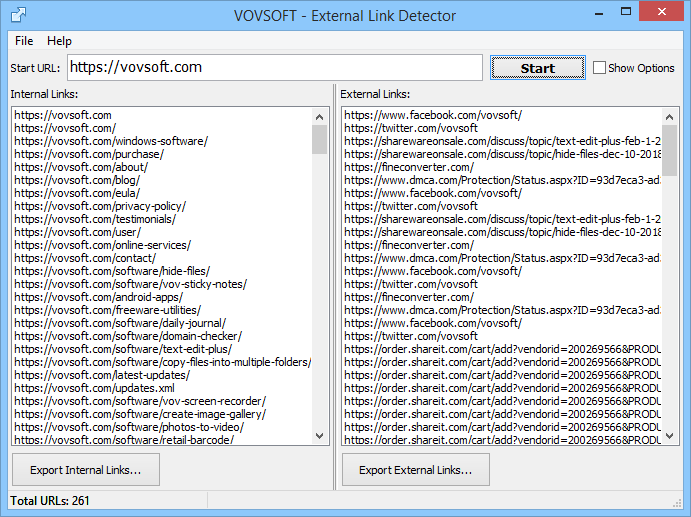
External Link Detector is a specialized utility designed to automate the process of auditing website link structures. The software identifies both internal and external links across any given domain, providing a comprehensive list of all outbound destinations. By automating this scan, the tool eliminates the need for manual inspection of individual web pages.
The utility serves several diagnostic purposes:
- Security: Identifying unauthorized or suspicious outbound links that may pose security risks or point to malicious content.
- Maintenance: Detecting broken external links to preserve the user experience and maintain search engine rankings.
- SEO Strategy: Locating expired domains within a site’s link profile which can be re-registered for traffic redirection or optimization purposes.
The application includes a set of advanced configuration options for technical users. In addition to the standard automated scanning functionality, users can select from multiple user-agents and manually set connection and response timeouts to suit specific server environments. For more targeted results, the software allows for the exclusion of specific URLs or file extensions during the scan. This ensures the output remains focused on relevant data points while reducing processing time during large-scale site audits.
Top 5 Reasons To Download External Link Detector
- Proactive Security Auditing: Instantly identify unauthorized, suspicious, or malicious external links that could compromise your site's integrity or visitor safety.
- Search Engine Optimization Recovery: Detect and fix broken external links that drain your "link juice" and hurt your rankings on Google and Bing.
- Automated Efficiency: Replace hours of manual, error-prone link checking with a high-speed automated scan that delivers a comprehensive map of your site’s architecture.
- Domain Hunting and Monetization: Discover expired domain names linked within a site, allowing you to register them for traffic redirection or SEO purposes.
- Advanced Technical Customization: Fine-tune your crawls with manual timeout settings, user-agent switching, and specific URL/file extension exclusions for professional-grade results.
If you have ever managed a website, whether it is a small personal blog or a massive e-commerce platform, you know that the internet is a living, breathing, and constantly changing entity. Links that worked yesterday might lead to a digital dead-end today. Worse yet, a site you linked to months ago might have changed ownership and could now be hosting content that puts your reputation at risk. Keeping track of where your visitors are going once they click a link on your page is one of the most overlooked aspects of digital maintenance. That is exactly why External Link Detector is a tool you cannot afford to pass up. In this review, I am going to break down why this specific giveaway is the upgrade your digital toolkit has been screaming for.
1. Proactive Security Auditing
The most critical reason to download this software is security. We live in an era where cyber threats are becoming increasingly sophisticated. One of the most common ways a website’s reputation is destroyed is through "link injection" or "malicious redirects." You might think your site is clean, but without a deep scan, you may have no idea that a comment section, a forum post, or even a hacked plugin has inserted outbound links to phishing sites or malware distributors. External Link Detector acts as your personal security sentry, revealing every single destination your site points to.
When you run a scan, the software doesn’t just look at the obvious links in your navigation bar; it dives into the code to find every outbound connection. This is vital for identifying unauthorized links. If you see a link to a suspicious domain that you didn't put there, you have found an immediate security breach that needs your attention. By identifying these malicious outbound paths, you protect your users from being redirected to harmful corners of the web. In the eyes of search engines, a site that links to "bad neighborhoods" is a site that shouldn't be ranked. Using this tool to purge those links is like giving your website a clean bill of health, ensuring that your digital footprint remains untainted and your users remain safe.
Furthermore, the software allows you to audit internal links just as easily. This is important because internal redirects can sometimes be exploited by attackers to create "open redirects," which are used in phishing campaigns to make a fake URL look like it belongs to your trusted domain. By having a full list of every internal and external link in one place, you gain total visibility over your site's exit points and internal pathways. You are no longer flying blind; you are in total control of the traffic flow.
2. Search Engine Optimization Recovery
Every SEO professional knows that broken links are the "silent killers" of search rankings. When a search engine crawler like Googlebot hits a 404 error on your site—or follows a link from your site to a 404 error on another site—it sends a signal that your website is neglected or poorly maintained. This leads to a loss of "crawl equity" and can significantly dampen your ability to rank for competitive keywords. But beyond the technical side, think about the user experience. Nothing frustrates a visitor more than clicking a promising link only to land on a "Page Not Found" screen. It erodes trust and causes users to bounce back to the search results, further signaling to Google that your site isn't providing value.
External Link Detector simplifies the process of finding these "link rot" issues. Instead of clicking every link on every page—a task that is virtually impossible for any site over ten pages—the software automates the detection. It allows you to quickly spot broken external links, giving you the opportunity to either remove the link or replace it with a fresh, working resource. This keeps your content relevant and your "link juice" flowing correctly.
By regularly using this tool, you are essentially performing a routine SEO audit that would normally cost hundreds of dollars if outsourced to a consultant. You are ensuring that every outbound signal your site sends is a signal of quality. High-quality outbound links to authoritative, working websites actually help your SEO by showing search engines that you are a hub of valuable information. This software ensures that your "hub" status is never compromised by dead ends or broken paths. It is an essential utility for anyone serious about climbing the search engine results pages.
3. Automated Efficiency
Let’s talk about the most precious resource any tech professional has: time. If you were to manually audit a 50-page website for links, you would have to open every page, click every link, check where it goes, and document the results. If each page has 20 links, that is 1,000 manual checks. It is tedious, it is soul-crushing, and it is prone to human error. You will miss things. You will get tired. You will skip pages. External Link Detector eliminates this entire headache with a single click of the "Start" button.
The beauty of this software lies in its simplicity and speed. You simply input the URL, and the application takes over. It crawls through the site's architecture, following the threads of connectivity that bind your pages together and lead away to the rest of the web. What would take a human being an entire weekend of work can be accomplished by this program in a fraction of the time. The efficiency gain here cannot be overstated. By automating the data collection process, the software frees you up to do the actual work of a webmaster: analyzing the data and making strategic decisions.
Moreover, the interface is designed for immediate productivity. There is no steep learning curve or complex manual to read before you can get started. It is built for the "power user" who wants results now. This automation makes it feasible to perform regular audits. Most people only check their links once a year because it is such a chore. With this tool, you can run a scan every Monday morning while you grab a cup of coffee. This ensures your site stays optimized and secure year-round, rather than just during a once-a-year "spring cleaning."
4. Niche Domain Discovery
This is the "secret weapon" feature that should make every digital marketer and entrepreneur sit up and take notice. One of the most powerful strategies in modern SEO and traffic generation is the acquisition of expired domains. When a website goes out of business or a blogger stops paying for their domain name, that domain eventually becomes available for anyone to register. However, there are often thousands of existing links across the web still pointing to that domain.
External Link Detector is a goldmine for finding these opportunities. By scanning high-authority websites or competitors in your niche, you can identify external links that point to domains that no longer exist. If you find a link to an expired domain, you can register that domain for yourself. Once you own it, you can redirect that "dead" traffic to your own website, or you can rebuild a site on that domain to take advantage of its existing SEO authority and backlink profile. This is a high-level tactic used by some of the most successful SEO agencies in the world, and this software puts that power directly into your hands.
Think of it as digital archeology. You are scanning the web for valuable relics that have been forgotten. Identifying these expired domains allows you to capture traffic that was meant for someone else, all while helping the original site owner by "fixing" a broken link (once you've bought the domain and redirected it). It is a win-win scenario that can provide a massive boost to your online presence. Whether you want to flip these domains for a profit or use them to build your own private blog network, this tool is the primary engine you need to find those hidden gems.
5. Granular Control for Power Users
While the software is easy enough for a beginner to use, it doesn't skimp on the advanced features that professionals demand. Most basic link checkers are "black boxes"—you put a URL in and you get whatever the software feels like giving you. External Link Detector is different. It offers a level of customization that allows you to tailor the scan to your specific needs, making the process significantly more efficient.
For starters, you can manipulate the User-Agent. This is a massive feature. Some websites behave differently depending on who (or what) is visiting them. By changing the user-agent, you can see how a site responds to different browsers or even how it responds to search engine bots. This is crucial for troubleshooting "cloaking" issues or seeing if a site is blocking certain types of crawlers. Additionally, the ability to manually input connection and response timeouts is a lifesaver when dealing with slow servers. You won't have the software hanging indefinitely on a sluggish page; you set the rules for when the program should move on.
Furthermore, the exclusion features are a masterclass in efficiency. If you know that your site has thousands of links to a specific sub-domain or a social media platform that you don't need to audit, you can simply tell the software to ignore those URLs. You can also define specific file extensions to avoid. If you don't want the scanner wasting time and bandwidth on .pdf, .zip, or .jpg files, you can exclude them entirely. This ensures that the scan focuses only on the HTML links that matter to you. This level of granular control means you aren't just getting a "comprehensive" list; you are getting a relevant list. It is professional-grade software that respects your specific workflow and technical requirements.
Conclusion
In the fast-paced world of web development and digital marketing, the difference between success and failure often comes down to the tools you have at your disposal. You can choose to do things the hard way—manually checking links, ignoring security risks, and missing out on SEO opportunities—or you can choose the path of the professional. External Link Detector is more than just a simple utility; it is an all-in-one solution for security, SEO, efficiency, and market research.
Every link, revealed in a click. That is not just a tagline; it is a promise of clarity in a digital landscape that is often confusing and opaque. Whether you are looking to protect your visitors from malicious redirects, boost your search engine rankings by fixing broken paths, or find the next great expired domain to jumpstart your traffic, this software provides the data you need to succeed. The fact that it offers such deep customization for power users while remaining accessible to novices makes it a rare find in the tech world.
Don’t wait until a broken link ruins a customer’s experience or a malicious outbound link gets your site blacklisted by Google. Take control of your outbound and internal architecture today. This giveaway is your chance to own a powerful piece of software that will save you time, improve your site's health, and potentially open up new avenues for revenue. Download External Link Detector now and start seeing your website for what it truly is—a perfectly mapped network of opportunities.

Reviews for External Link Detector
Click Here to Read Reviews for External Link Detector >> Click Here to Submit Reviews for External Link Detector >>