What Does Windows Explorer Tracker Do?
Windows Explorer Tracker is a utility designed to monitor and record file system activity within the Windows environment. The software automatically traces various operations across files, folders, drives, and external storage media. It is intended for users who require a granular log of system changes for administrative or auditing purposes.
The application captures a wide range of actions, including:
- Delete and Rename operations
- Create and Insert actions
- Add and Remove events for storage media
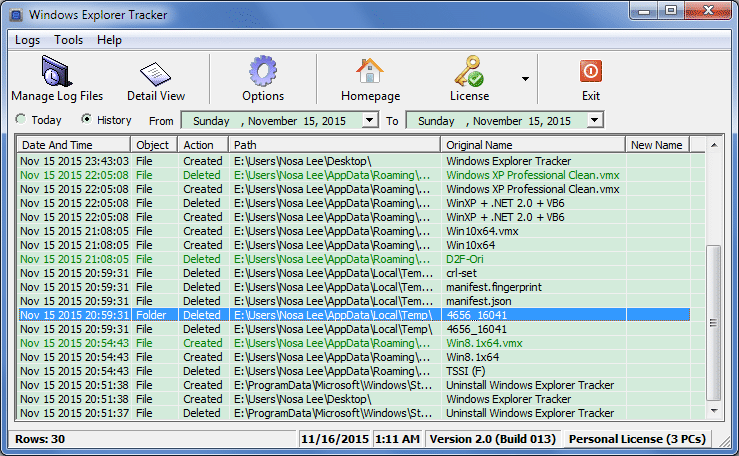
Beyond local monitoring, the tool supports tracking on remote hosts via mapped network drives. All activities are recorded in .log files, which are automatically organized by date to streamline record management. The primary interface allows users to load history logs by specifying a start and end date, making it possible to locate specific file operations quickly.
Additionally, users can manage these log files within Windows Explorer, permanently delete history records, and customize the display format for date and time stamps. This software provides a systematic method for retracing Windows activity and maintaining a historical record of file system modifications.
Top 5 Reasons To Download Windows Explorer Tracker
- Complete Visibility Across Every Storage Medium
- Granular Tracking of Essential File Operations
- Powerful Remote Host Monitoring via Mapped Drives
- Intelligent, Date-Based Log Organization and Management
- Enhanced Digital Accountability and Forensic Troubleshooting
Have you ever sat down at your computer, opened a folder where you were certain you left an important document, only to find it gone? Or perhaps you have noticed a mysterious new folder on your desktop and wondered which background process or user put it there? For the average user, the inner workings of the Windows File Explorer are something of a black box. Files move, folders are renamed, and data is deleted, often without leaving a clear trail of breadcrumbs for us to follow. This is exactly where Windows Explorer Tracker steps in, acting as a high-definition security camera for your entire file system. In this review, I am going to break down why this specific giveaway is a must-have addition to your utility toolkit, and why you should grab it before it is gone.
1. Complete Visibility Across Every Storage Medium
The modern computing environment is no longer just about a single internal hard drive. Most of us are juggling an array of storage devices: internal SSDs for speed, massive HDDs for long-term storage, external USB drives for backups, and SD cards for our cameras or mobile devices. Managing and monitoring what happens across all these different interfaces is a logistical nightmare. Windows Explorer Tracker solves this by providing a unified monitoring solution that supports files, folders, drives, and even removable storage media.
Think about the last time you plugged in a thumb drive to transfer some photos. Did you accidentally move a folder instead of copying it? Did an automated backup script delete older versions of files on your external drive without you noticing? By downloading this software, you gain a comprehensive oversight tool that treats every piece of hardware as part of a single, trackable ecosystem. It doesn't matter if the activity is happening on your primary C: drive or an obscure partition on a secondary disk; if Windows Explorer is interacting with it, this app is recording it. This level of breadth is rare in lightweight utilities, making it a powerhouse for anyone who deals with a high volume of data across multiple physical devices.
Furthermore, the support for Storage Media specifically means that the software is optimized to detect the Insert and Remove actions. This is incredibly useful for security. If someone plugs an unauthorized USB drive into your workstation while you are away, the software will log that insertion. If they then copy sensitive files onto that drive, you will have a timestamped record of exactly what happened. This isn't just a file tracker; it is a full-spectrum activity monitor that keeps you informed about every change to your hardware landscape.
2. Granular Tracking of Essential File Operations
Many system monitors provide vague "activity" logs that are hard to decipher. They might tell you that a folder was "accessed," but they don't tell you what actually happened to the data inside. Windows Explorer Tracker excels because it focuses on the actions that actually matter: Delete, Rename, Create, Insert, Add, and Remove. These are the critical operations that change the state of your digital life, and having a precise log of them is invaluable.
Let’s consider the Rename function for a moment. Renaming a file is one of the most common ways to "lose" data. You change a file name to something cryptic, forget what it was, and suddenly your search queries turn up nothing. With this software, you can simply look at your log and see that "Project_Final_v1.docx" was renamed to "Temporary_Notes.docx" at 2:15 PM on Tuesday. The mystery is solved instantly. The same logic applies to the Delete operation. We have all accidentally hit the delete key or dragged a folder into the recycle bin without realizing it. Seeing a log entry that confirms a file was deleted allows you to act quickly to recover it before the recycle bin is emptied or the sectors are overwritten.
The Create and Add operations are equally vital for those who want to maintain a clean system. If you install a new piece of software and want to know exactly what folders it is adding to your AppData or System32 directories, this tracker will list them all. It provides a level of transparency that Windows itself simply does not offer in an easy-to-read format. By capturing these specific actions, the software transforms from a simple logger into a sophisticated diagnostic tool that empowers you to understand the "how" and "when" of every file system change.
3. Powerful Remote Host Monitoring via Mapped Drives
In today's connected world, many of us are working with more than just our local machines. Whether you are running a small home office with a Network Attached Storage (NAS) device, or you are managing a small business network, remote file management is a standard part of the workflow. One of the standout features of Windows Explorer Tracker—and a primary reason why I recommend this giveaway so highly—is its ability to track remote hosts via mapped network drives.
Tracking activity on a local machine is one thing, but tracking what happens on a server or a remote computer across a network is usually a much more complex task involving expensive enterprise software. This app simplifies that process. By mapping a remote folder as a network drive on your local machine, you can point the tracker at that drive and monitor it as if it were a local disk. This is a game-changer for collaborative environments. If you share a folder with a colleague and a file goes missing, you can check your logs to see if they accidentally deleted or moved it from their end.
This functionality is also a massive boon for home users who utilize a media server. If your movie or music library is hosted on a different machine, you can keep an eye on file integrity and changes without having to sit at the remote terminal. The flexibility to monitor remote activity through a local interface makes this software incredibly versatile. It bridges the gap between basic desktop monitoring and professional network administration, providing high-end utility without the high-end price tag or complexity.
4. Intelligent, Date-Based Log Organization and Management
Data is only useful if it is organized. A monitoring tool that dumps 50,000 lines of text into a single file is almost as useless as having no log at all. Windows Explorer Tracker demonstrates its sophistication through its intelligent management of log files. It saves operations by date, automatically naming the .log files in a way that makes logical sense. This chronological approach to data storage is the gold standard for management and retrieval.
When you open the main interface, you aren't greeted by a confusing wall of text. Instead, you have the ability to Quickly Load History Logs by specifying a start and end date. If you know that a file went missing sometime last Thursday, you don't have to scroll through weeks of data. You simply select Thursday's date, and the software presents you with the specific activity for that 24-hour window. This saves an enormous amount of time and frustration, making it a practical tool for daily use rather than a chore to manage.
Beyond just viewing the logs, the software gives you the power to manage them effectively. You can open the log files directly in Windows Explorer, search for specific keywords or operations (like "Delete"), and even permanently delete history operations if you no longer need them. This ensures that the software doesn't become a "storage hog" on your system. Furthermore, the Options interface allows you to customize the display format of the date and time. Whether you prefer a 24-hour clock or a specific regional date format, the software adapts to your preferences. This focus on user experience and organizational efficiency is a hallmark of well-designed utility software, and it ensures that your tracking data remains an asset rather than a burden.
5. Enhanced Digital Accountability and Forensic Troubleshooting
The final, and perhaps most compelling, reason to download this giveaway is the peace of mind it provides through accountability. We share our computers more often than we realize—with family members, children, or even coworkers. When something goes wrong with the system, the first question is always "What changed?" Without a tracker, you are left guessing. With Windows Explorer Tracker, you have an objective, unchangeable record of the truth.
For parents, this tool can be used to ensure that children aren't accidentally deleting important work files or installing unauthorized software. For professionals, it provides a "forensic" trail that can be used to troubleshoot software conflicts. If a program starts crashing after a new update, you can look at the logs to see if that update modified or deleted any shared DLLs or configuration files. It turns you into a digital detective, capable of diagnosing issues that would otherwise require a professional IT consultant.
Accountability also extends to your own habits. We all make mistakes—we drag-and-drop things into the wrong place or accidentally overwrite a file. Using this software allows you to "retrace your steps." By looking at your own activity history, you can see exactly where you went wrong and fix the error before it causes permanent data loss. In an era where our digital files represent our memories, our work, and our identities, having a tool that provides this level of security and "undo" potential is not just a luxury; it is a necessity. This giveaway is an opportunity to add a layer of professional-grade protection to your personal computer, ensuring that you are always in control of your data, no matter what happens.
In conclusion, Windows Explorer Tracker is a lean, efficient, and powerful utility that addresses a fundamental gap in the Windows operating system. It provides the clarity, organization, and remote capabilities that power users and casual users alike need to manage their files safely. From its ability to track across all storage media to its granular action logging and intelligent date-based organization, it is a comprehensive solution for anyone who values their data. Don't miss out on this chance to download a tool that offers such immense practical value. It is the kind of software that you might not realize you need today, but you will be incredibly grateful you have it the next time a file goes missing or a system error occurs. Grab this giveaway now and take the first step toward a more transparent and secure computing experience.

Reviews for Windows Explorer Tracker
Click Here to Read Reviews for Windows Explorer Tracker >> Click Here to Submit Reviews for Windows Explorer Tracker >>