What Does SysResources Manager Do?
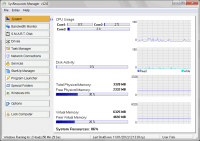
SysResources Manager is a comprehensive system utility designed to provide real-time oversight of hardware and software performance. The application monitors core system resources, including CPU utilization, RAM availability, and virtual memory status, presenting data through detailed usage graphs. This allows users to track how their machine handles various workloads throughout the day.
For storage and connectivity management, the tool tracks hard disk health and drive performance. Networking features include a bandwidth traffic monitor that measures download and upload speeds, alongside a specific tracker for processes currently accessing the internet. These tools allow users to identify which applications are consuming the most system resources or data in real-time.
The software also functions as an administrative hub, featuring an integrated Task Manager for managing active processes and a dedicated Windows Services viewer. Users can audit their boot sequence through the StartUp Manager or utilize the built-in Program Launcher to streamline their workflow. This centralized approach simplifies system maintenance by consolidating various internal administrative tools into a single interface.
Additionally, SysResources Manager offers quick access to Windows Information, Control Panel items, and system-defined special folders. Practical utility features include a command to lock the PC directly from the interface. The software serves as an all-in-one dashboard for users requiring detailed telemetry and granular control over their Windows environment.
Top 5 Reasons To Download SysResources Manager
- Comprehensive Real-Time Resource Visualization: Gain immediate, graphical insight into your CPU, RAM, and Virtual Memory usage to eliminate system bottlenecks.
- Granular Network and Bandwidth Transparency: Monitor your upload and download speeds in real-time while identifying exactly which processes are accessing the internet.
- Proactive Hard Drive Health and Performance Monitoring: Keep a close eye on your storage reliability and disk activity to prevent data loss before it happens.
- Streamlined Startup and Service Management: Reclaim your boot times and system speed by managing hidden services and unnecessary startup programs.
- The Ultimate System Access Hub: A centralized "Swiss Army Knife" for accessing Windows special folders, Control Panel items, and system info from a single interface.
If you are anything like me, you treat your PC like a high-performance engine. You want to know exactly what is happening under the hood at all times. You want to know why the fans are spinning up, why that particular application is sluggish, and which "hidden" process is hogging your precious bandwidth. Most of us rely on the built-in Windows Task Manager, but let’s be honest: it often feels like looking through a keyhole when you need a panoramic window. That is where SysResources Manager steps in. This utility isn't just another system tool; it is a comprehensive command center for anyone who takes their hardware seriously. Today, we are looking at a giveaway that you absolutely cannot afford to pass up. In this review, I am going to break down why this specific piece of software needs to be in your digital toolkit right now.
1. Comprehensive Real-Time Resource Visualization
The heartbeat of any computer is its processor and memory. When things go south, these are the first two places we look. However, the standard Windows tools often provide a dry, numerical representation that lacks context. SysResources Manager changes the game by offering highly detailed usage graphs for all your important system resources. We are talking about real-time tracking of CPU usage, physical RAM, and—critically—Virtual RAM.
Why does Virtual RAM matter? Many users overlook the page file, but when your physical RAM fills up, your system starts leaning on your hard drive to simulate memory. This is usually where the "lag" begins. By having a dedicated monitor for Virtual RAM, you can see exactly when your system is overextending itself. The graphical interface allows you to spot spikes that might last only a fraction of a second—spikes that a numerical readout might miss. For gamers, video editors, and power users, this level of visualization is indispensable. You can finally see the "stress" your system is under during peak workloads, allowing you to make informed decisions about hardware upgrades or software optimizations.
Furthermore, the software doesn’t just show you that the CPU is busy; it helps you understand the ebb and flow of your processing power. If you notice a consistent spike every five minutes, you can begin to hunt down the background task responsible. It’s about moving from "my computer is slow" to "my CPU is spiking because of a specific background indexer." That transition is what turns a regular user into a power user, and this giveaway provides the perfect entry point for that level of control.
2. Granular Network and Bandwidth Transparency
In our hyper-connected world, your network is just as vital as your CPU. We have all experienced that moment where the internet feels sluggish, but a speed test shows your line is fine. Usually, this means some rogue process is "calling home" or downloading a massive update in the background without your permission. SysResources Manager provides a level of network transparency that is usually reserved for expensive enterprise-grade monitoring tools.
The software features a dedicated Network Bandwidth Traffic monitor that displays your current Download and Upload speeds in real-time. This is great for verifying that you are getting the speeds you pay for, but the real "killer feature" is the ability to see exactly which processes are accessing the internet. This is a massive win for both productivity and security. If you see an unknown process uploading data at 2 AM, you have caught a potential security threat or a piece of "telemetry" software that is overstepping its bounds.
For those on metered connections or anyone who works remotely, knowing your bandwidth allocation is essential. You can identify if a background cloud sync is eating up your bandwidth during an important video call. Instead of guessing, you get a list of active connections. This granular view allows you to see the IP addresses and ports being used, giving you the power to shut down bandwidth-hungry applications and prioritize what really matters. This giveaway puts a professional-grade network sniffer’s results into a user-friendly interface that anyone can understand.
3. Proactive Hard Drive Health and Performance Monitoring
Your data is the most valuable thing on your computer. Your photos, documents, and projects are often irreplaceable. While we all know we should back up our data, we often wait until a drive fails before we take action. SysResources Manager acts as an early warning system for your storage devices. It monitors both the health and the performance of your Hard Disks and SSDs, ensuring you aren't caught off guard by a hardware failure.
Disk health monitoring goes beyond just seeing if a drive is "on." It looks at the internal metrics of the drive to identify signs of wear and tear. If your drive starts showing read/write errors or increased latency, the software flags it. This allows you to migrate your data to a new drive long before the old one clicks its last click. In the tech world, we call this proactive maintenance, and it is the difference between a minor afternoon chore and a catastrophic loss of years of work.
Additionally, the Disk Performance aspect allows you to see how fast your drives are actually working during file transfers. Are you getting the advertised speeds of your NVMe SSD? Is your external backup drive bottlenecking your workflow? By monitoring the disk activity graphs, you can see if your drive is constantly at 100% utilization—a common cause of system "freezes." Understanding the physical state of your disks is the foundation of a stable system, and this tool makes that complex data easily accessible.
4. Streamlined Startup and Service Management
Over time, every Windows installation begins to suffer from "software rot." Every app you install wants to start when the computer turns on, and many of them leave behind "services" that run in the background even when the app is closed. This is the primary reason why a PC that felt lightning-fast on day one feels like a turtle a year later. SysResources Manager includes a powerful StartUp Manager and a Windows Services manager that give you back control over your boot sequence.
The StartUp Manager allows you to see every single application that is set to launch at login. Many of these are "helpers" or "updaters" that you simply don't need running 24/7. By disabling these, you can shave seconds—or even minutes—off your boot time and free up significant amounts of RAM for the apps you actually use. Unlike the basic startup tab in the default Windows settings, this utility provides a deeper dive into the registry entries and folder locations of these programs.
Then there are the Windows Services. This is a "no-go zone" for many users because the default Windows interface for services is intimidating and cryptic. SysResources Manager presents this information in a much more digestible format. You can see which services are running, which are stopped, and which are set to start automatically. This is particularly useful for stopping resource-heavy services that you don't need, such as print spoolers if you don't own a printer, or remote registry services that could pose a security risk. By trimming the fat from your active services and startup list, you are essentially giving your PC a performance tune-up that pays dividends every single time you hit the power button.
5. The Ultimate System Access Hub
Finally, let's talk about convenience. One of the most underrated features of SysResources Manager is its role as a centralized hub for Windows navigation. Windows has a habit of hiding important settings and folders deep within sub-menus. This software includes a Program Launcher and quick access to "Special Folders" (like AppData, System32, and Program Files) that saves you from clicking through endless directories in File Explorer.
Need to access a specific Control Panel item? You can do it directly from the app. Need to check your detailed Windows Info, like your build number or installation date? It’s right there. It even includes a quick "Lock PC" function and access to the Task Manager for those times you need to force-quit an unresponsive application. This turns the software into a "mission control" for your entire operating system.
Think about the time you waste hunting for the right setting in the ever-changing Windows 10/11 Settings menu versus the classic Control Panel. SysResources Manager bridges that gap, providing a consistent, reliable interface to reach the tools you use most. It is this combination of monitoring and management that makes it so valuable. It doesn’t just tell you what is wrong; it gives you the shortcuts to fix it. As a tech reviewer, I see hundreds of utilities, but few manage to bundle this much utility into a single, lightweight package without it feeling cluttered or overwhelming.
In conclusion, SysResources Manager is a must-download for anyone who wants to take their PC ownership to the next level. Whether you are troubleshooting a specific issue, trying to speed up an old machine, or just curious about how your hardware is performing, this software provides the answers in a clear, graphical, and actionable way. Because this is a giveaway, there is absolutely no risk in trying it out. You are getting a premium system utility that replaces three or four other programs, saving you system resources and disk space in the process. Don't wait until your computer crashes or your bandwidth is hijacked—download this giveaway today and see what your PC is actually doing.
Make sure to grab this while it's available! A tool that offers this much insight into CPU, RAM, Network, and Disk health is a rare find in the giveaway circuit. It’s time to stop guessing and start knowing exactly how your system is performing. Your hardware will thank you.


Reviews for SysResources Manager
Click Here to Read Reviews for SysResources Manager >> Click Here to Submit Reviews for SysResources Manager >>