What Does DiskFerret Do?
DiskFerret is a disk space analysis tool designed to visualize and manage storage consumption on Windows systems. As data volumes expand, identifying the specific files and folders occupying drive space becomes critical for maintaining system performance. The application utilizes a standard tree view interface, mirroring Windows Explorer, to navigate local drives, network shares, and specific folders. It identifies the largest items first, allowing users to prioritize the most impactful deletions or archives.
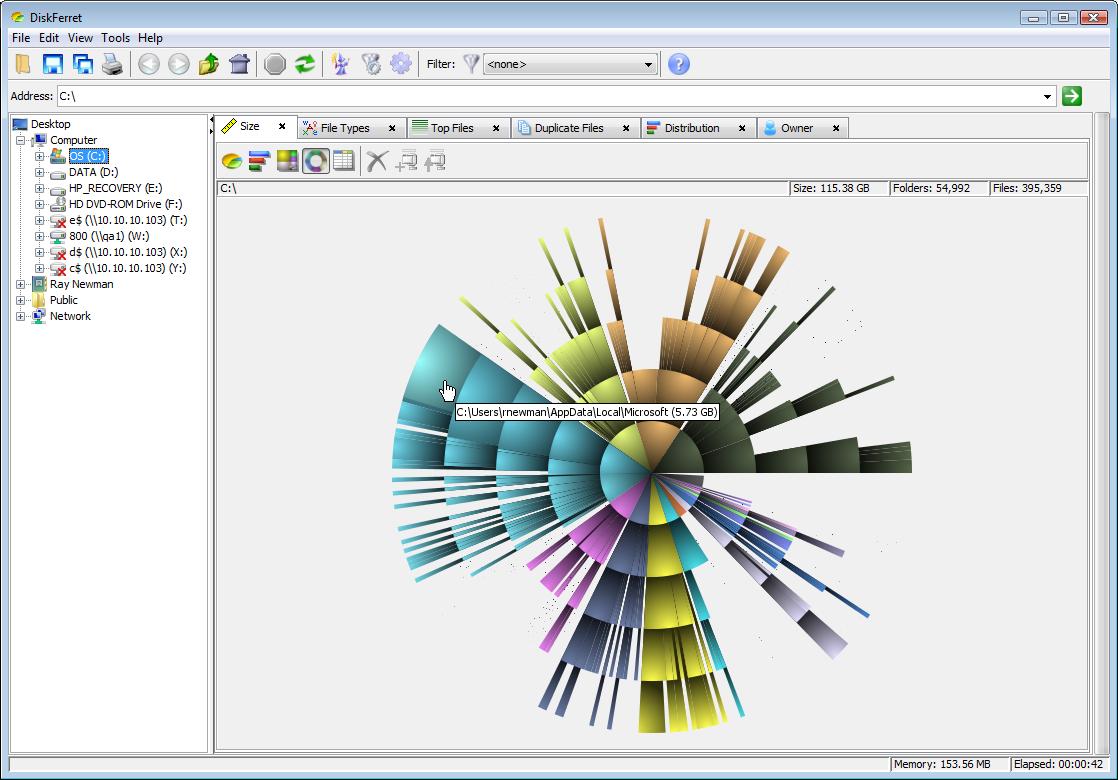
The software provides several specialized data views, including breakdowns by file size, owner, type, and distribution. Users can identify duplicate files using configurable criteria such as CRC-32 checksums, file names, and dates. Visualization options include pie charts, bar graphs, ring charts, and treemaps, which represent file systems as nested rectangles. For rapid maintenance, a Cleanup Wizard guides users through removing internet cache, cookies, and temporary system files.
Advanced functionality includes filters to include or exclude specific file types—such as audio, video, or executable files—and the ability to globally exclude directories like the Windows folder. Once identified, unwanted files can be deleted or compressed into ZIP archives directly within the interface. Scans can be saved as .dfscan files for later review, and any data view can be printed for documentation purposes. Users can also customize the interface using a variety of included skins.
Top 5 Reasons To Download DiskFerret
Before we dive into the nitty-gritty details of why this software is a must-have for your digital toolkit, let's look at the highlights. If you are tired of seeing that dreaded "Low Disk Space" warning, here are the top five reasons you need to download DiskFerret today:
- Instant Visual Clarity: Transform confusing lists of files into intuitive Treemaps, Pie charts, and Ring charts that show you exactly where your space went.
- High-Precision Duplicate Detection: Go beyond simple filename matching with CRC-32 checksum technology to find and eliminate identical files wasting your storage.
- The Comprehensive Cleanup Wizard: A step-by-step guide that handles everything from system temp files to browser caches and document histories.
- Granular Filtering and Ownership Tracking: Isolate specific file types like video or audio and identify which users are hogging the most resources on shared drives.
- Powerful "Delete and Zip" Integration: Don’t just find the bloat—fix it immediately by compressing or removing files directly within the app’s interface.
We have all been there. You are right in the middle of downloading a massive new game, editing a high-definition video project, or trying to save a critical work presentation when Windows hits you with that cold, heartless notification: "Disk space is running low." In the modern era, we tend to think that because 2TB or 4TB drives are relatively inexpensive, storage is no longer an issue. But the reality is that our data consumption is growing even faster than hardware prices are falling. High-res photos, 4K video files, and increasingly bloated software installations can turn a massive hard drive into a cramped digital attic in no time.
While you could spend hours manually clicking through every folder in Windows Explorer or trying to run complex scripts in the Command Prompt, there is a much better way to reclaim your digital life. DiskFerret is designed to do the heavy lifting for you. It is a sophisticated, yet incredibly user-friendly tool that hunts down the "space hogs" on your system so you can get back to work. As a tech reviewer who has seen hundreds of "utility" apps, I can tell you that DiskFerret stands out because it doesn't just give you data; it gives you insight. Let’s break down exactly why this is a giveaway you cannot afford to miss.
1. Instant Visual Clarity Through Advanced Charting
One of the biggest problems with standard file management tools like Windows Explorer is that they are text-heavy. You see a list of folders, but you have no idea if "Folder A" contains 5MB or 50GB without right-clicking and waiting for the properties to load. DiskFerret changes the game by offering a variety of Data Views that turn your file system into a visual map.
The Treemap Chart is, in my opinion, the star of the show. It displays your file system as a set of nested rectangles. Each folder is represented by a rectangle, and its size is proportional to the amount of disk space it occupies. This allows you to spot a "giant" folder buried deep within your subdirectories instantly. You don’t have to hunt; your eyes are naturally drawn to the largest blocks on the screen. If you prefer a different perspective, you can switch to Ring Charts, Pie Charts, or Bar Graphs. Each of these views provides a unique way to understand the relative disk space occupied by different categories of data.
For those who prefer the traditional look, the Table View offers a spreadsheet-like experience where you can sort by any metric imaginable. This combination of visual and analytical tools means that whether you are a visual learner or a data-driven power user, you can find the source of your storage woes in seconds rather than minutes.
2. High-Precision Duplicate Detection
Duplicate files are the silent killers of hard drive performance. They accumulate through accidental double-downloads, redundant backups, or simply moving files around without deleting the originals. Most "duplicate finders" are lazy; they only look at the filename. If you have "Vacation_Photo.jpg" and "Vacation_Photo(1).jpg," they might find it, but if you renamed one to "Sunset.jpg," a standard tool would miss it entirely.
DiskFerret is different. Its Duplicate File View allows you to configure specific criteria for what constitutes a duplicate. You can match by name and size, sure, but the real power lies in the CRC-32 checksum analysis. This feature creates a digital fingerprint of the file's actual contents. If the fingerprints match, the files are identical, regardless of what they are named or when they were created. This level of precision ensures that you aren't deleting unique files by mistake, while simultaneously finding every last bit of redundant data hiding on your network shares or local drives.
Once identified, DiskFerret makes it incredibly easy to act. You can see exactly where the duplicates live and decide whether to wipe them out or archive them. This feature alone can often reclaim 10% to 20% of a user's disk space, making the software pay for itself in saved hardware costs almost immediately.
3. The Comprehensive Cleanup Wizard
Finding the problem is only half the battle. Once you know where the space is going, you need to take action. This is where many disk analysis tools fall short—they show you the mess but leave you to clean it up. DiskFerret includes a dedicated Cleanup Wizard that acts as a guided tour for system optimization. This isn't just a "delete" button; it’s an intelligent interface that walks you through various categories of unwanted information.
The wizard helps you target files that are no longer needed by any applications on your system. It goes deep into the corners of your OS, helping you clear out your Internet Explorer cache, cookies, and history. It also looks at your desktop "run" history and document histories, which can accumulate over time and contribute to system sluggishness. By following the step-by-step choices, even a novice user can safely remove junk files without the fear of breaking their operating system. It’s like having a professional IT consultant sitting next to you, pointing out exactly what is safe to throw away.
4. Granular Filtering and Ownership Tracking
Sometimes the problem isn't "junk" files, but rather a specific type of data that has gotten out of control. DiskFerret’s File Type View is an essential tool for photographers, videographers, and music collectors. It categorizes your storage by file extension, so you can see exactly how many gigabytes are being taken up by Video Files versus Image Files or Executables.
The software comes with pre-configured Filters for common categories like Audio, Data, Documents, and Temporary files. This allows you to isolate specific types of data. For example, if you know you have a lot of large video files but don’t know where they are, you can apply the Video Filter to see a narrowed-down view of your drive. Suddenly, that forgotten folder of raw footage from three years ago becomes impossible to hide.
For those working in a multi-user environment or managing a network share, the Owner View is a lifesaver. It breaks down disk usage by file owner, showing you exactly which user account is responsible for the most data. This is perfect for system administrators who need to manage quotas or for parents who want to see which child is filling up the family PC with game mods and screen recordings. You can drill down to see exactly where those users' files are located, providing a level of transparency that Windows Explorer simply cannot match.
5. Powerful "Delete and Zip" Integration and Workflow Features
A tool is only as good as its integration into your existing workflow. DiskFerret was clearly built with the user's time in mind. The Tree View interface will feel instantly familiar to anyone who has used Windows, meaning there is virtually no learning curve. You navigate your drives and network resources just like you always have, but with a massive boost in the data being presented to you.
When you find a massive folder that you don't need right now but aren't ready to delete forever, DiskFerret offers a Delete and Zip function. You can compress unwanted folders into a Zip file directly within the app. You have the option to either copy or move the files to the destination zip, allowing for quick archiving. This is a massive time-saver compared to the "find-in-app, locate-in-explorer, right-click-to-zip" routine we are all used to.
Furthermore, DiskFerret allows you to Open, Save, and Save As scan results. This means you can run a massive scan on a 10TB network drive overnight, save the .dfscan file, and review it later or even send it to a colleague. Because DiskFerret establishes a file association during installation, you can simply double-click a scan file in Windows Explorer to launch the app and see the results immediately. It even supports Skins, so you can customize the graphical user interface to match your personal aesthetic. Whether you want a high-contrast dark mode or a sleek modern look, the app can be tailored to your style.
Conclusion: Why You Need This Now
In the world of tech utilities, there are "nice-to-have" apps and "essential" apps. DiskFerret firmly belongs in the essential category. As our digital lives continue to expand, the ability to manage our storage efficiently becomes a core skill. Using the "trim the budget" technique—looking at the largest items first—is the most logical way to maintain a healthy, fast PC. DiskFerret makes this technique accessible to everyone, regardless of their technical expertise.
By downloading this giveaway, you are not just getting a piece of software; you are getting a permanent solution to the frustration of full hard drives. You are getting the ability to see your data through beautiful charts, clean your system with a guided wizard, hunt for duplicates with checksum precision, and organize your files with powerful filters. It is a comprehensive, professional-grade tool wrapped in an interface that anyone can master.
Don’t wait until your computer grinds to a halt or you are forced to delete something important in a panic to make room for a new file. Take control of your storage today. DiskFerret is the ferret you want in your digital holes, sniffing out the waste and helping you reclaim your space. This is one download you will find yourself returning to month after month, year after year. It is time to stop guessing where your disk space went and start knowing. Download DiskFerret now and experience the satisfaction of a clean, optimized, and spacious hard drive.
Summary of Benefits:
- Speed: Find large files in seconds that would take hours to find manually.
- Precision: Use CRC-32 checksums to ensure duplicates are actually duplicates.
- Simplicity: Use the Cleanup Wizard to safely remove system junk without advanced knowledge.
- Visualization: Use Treemaps and Ring charts to understand your data at a glance.
- Portability: Save and share scan files to manage remote systems or keep records of disk growth.
This is a top-tier utility that delivers on every promise. If you value your time and your system's performance, this is the giveaway for you.

Reviews for DiskFerret
Click Here to Read Reviews for DiskFerret >> Click Here to Submit Reviews for DiskFerret >>