What Does Camboard Computer Explorer Do?
Camboard Computer Explorer is an interactive educational tool designed to provide a detailed visualization of computer hardware and architecture. The software offers a three-dimensional environment where users can examine the internal components of a computer tower without the need for physical disassembly. It serves as a digital laboratory for students and educators focused on computer science fundamentals.
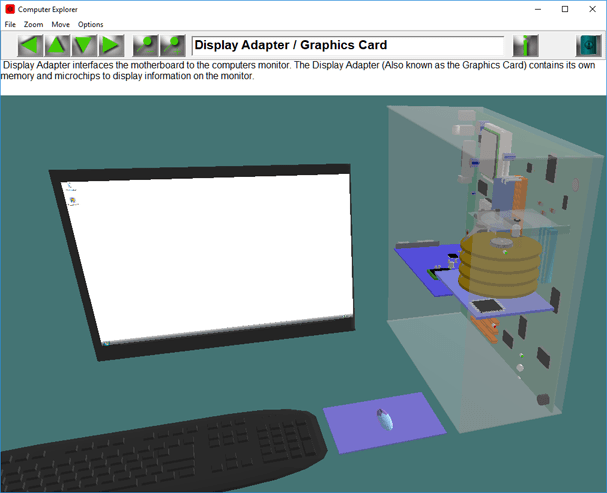
The application features a fully rendered virtual computer system, including peripheral devices such as the monitor, keyboard, and mouse. Users can navigate the 3D space using zoom and pan controls to inspect specific hardware elements from various angles. This spatial exploration allows for a comprehensive view of how individual components are situated within the chassis and how they connect to one another.
Beyond visual observation, the software includes interactive informational layers. When a user selects a specific internal component, the program displays a technical description detailing the part's specific role and function within the system. This functionality bridges the gap between identifying a component and understanding its operational significance. The tool is structured to facilitate a fundamental understanding of how hardware components integrate to form a functional machine, making it a practical resource for introductory computer science curriculum.
Top 5 Reasons To Download Camboard Computer Explorer
1. Immersive 3D Visualization of Complex Hardware: It transforms flat, boring textbook diagrams into a fully realized virtual environment where you can see the spatial relationships between components.
2. Zero-Risk Exploratory Learning: You get to explore the sensitive internals of a computer system without the risk of static discharge, broken pins, or voiding your hardware warranties.
3. Instant Access to Component Metadata: With a simple click, the software provides immediate, easy-to-understand descriptions of what each part does, bridging the gap between sight and knowledge.
4. A Holistic View of the Computing Ecosystem: Unlike tools that focus only on the motherboard, this software includes the monitor, keyboard, and mouse to show how user input translates to internal processing.
5. Intuitive Pan and Zoom Controls: The fluid navigation system allows users of all ages to inspect the smallest microchips or the largest cooling fans with professional-grade precision.
The Power of Virtual Exploration
In the modern era, we are surrounded by technology. We carry computers in our pockets, we work on them for eight hours a day, and we use them to connect with loved ones across the globe. Yet, for the vast majority of people, the "computer" remains a mysterious black box—or more accurately, a mysterious glowing rectangle. When something goes wrong, or when a student asks how the internet actually "gets inside" the machine, most people are at a loss for words. This is where Camboard Computer Explorer steps in to change the game. As a tech reviewer who has seen countless educational suites, I can tell you that there is something uniquely compelling about this specific software. It isn't just a slideshow; it is an invitation to deconstruct the digital world.
The beauty of this giveaway is that it tackles one of the biggest hurdles in computer science education: the intimidation factor. Computers are expensive, and their internal components are notoriously fragile. If you are a teacher, a parent, or even a curious adult, the idea of cracking open a 1,000-dollar machine just to see what a heat sink looks like is terrifying. Camboard Computer Explorer removes that fear entirely. It provides a high-fidelity virtual tower that acts as a digital twin to the machines we use every day. Let’s dive deep into the five reasons why you need to hit that download button right now.
1. Immersive 3D Visualization of Complex Hardware
For decades, learning about computer hardware involved looking at grainy, 2D photographs in a textbook. You would see a picture of a motherboard, but you couldn’t tell how thick it was, how the RAM clicked into the slots, or how the cables snaked around the power supply. The 3D engine used in Camboard Computer Explorer changes that paradigm entirely. When you boot up the software, you aren't looking at a static image; you are looking at a mathematical model of a computing system.
Being able to rotate the virtual tower allows the brain to process the information spatially. You begin to understand that the CPU isn't just a square on a page—it's a component nestled deep beneath a cooling fan, connected to a socket that is the heart of the motherboard. This spatial awareness is crucial for anyone who eventually wants to build their own PC or work in IT repair. The immersive nature of the 3D graphics makes the learning process feel more like a video game and less like a chore. It captures the imagination of younger students who are used to interactive environments like Minecraft or Roblox, and it applies that same level of engagement to real-world science.
2. Zero-Risk Exploratory Learning
As a tech reviewer, I often get emails from parents asking if they should let their kids build a computer. My answer is always a hesitant "yes," followed by a long list of warnings about static electricity and the dangers of forced components. The reality is that one wrong move with a screwdriver can result in a short circuit that ruins a motherboard. Camboard Computer Explorer provides the ultimate "sandbox" for this type of curiosity. It is a risk-free environment where you can click, zoom, and inspect to your heart's content without any financial consequences.
Think of this software as a flight simulator, but for computer technicians. Pilots don't start in the cockpit of a Boeing 747; they start in a simulator where mistakes don't result in disaster. Similarly, a student can use this software to familiarize themselves with the layout of a computer tower. They can learn where the GPU sits in relation to the PCI slots and understand the bulkiness of the power supply unit. By the time they actually do stand in front of a physical computer with a screwdriver in hand, they will have the confidence of someone who has "been there before." This download isn't just software; it's a safety net for your wallet and a boost for your confidence.
3. Instant Access to Component Metadata
Identification is the first step toward mastery. If you open a real computer, you see a bunch of green plastic, some metal fins, and a lot of colorful wires. Unless you already know what you're looking at, it's just a pile of high-tech junk. Camboard Computer Explorer solves this problem through its interactive labeling and description system. As you pan through the 3D environment, you can click on any specific part—the Hard Drive, the RAM, the CPU, the CMOS battery—and the software immediately displays a clear, concise description of what that part is and what it does.
This "just-in-time" learning is incredibly effective. Instead of reading a chapter about "Memory" and then trying to find it in a machine, the user finds the component first, sparked by visual curiosity, and is then rewarded with the information. This creates a much stronger mnemonic link in the brain. The descriptions are tailored to be accessible, making them perfect for beginners while still being technically accurate enough for more advanced students. It turns the computer tower into an interactive museum exhibit where the user is the curator.
4. A Holistic View of the Computing Ecosystem
One of the most common mistakes in computer science education is focusing too much on the "brain" and ignoring the "body." Many educational tools show you a motherboard in isolation, but they fail to show how that motherboard interacts with the world. Camboard Computer Explorer takes a holistic approach by including the monitor, keyboard, and mouse in its virtual environment. This is a brilliant design choice because it helps the user visualize the flow of data.
When you see the monitor sitting next to the tower, you begin to understand the role of the graphics card and the video ports. When you see the mouse and keyboard, you understand the concept of input devices. By showing the entire system, the software helps demystify the "magic" of computing. It shows that a computer is not just one thing, but a collection of specialized parts working in harmony to translate physical movement (like a mouse click) into digital signals, which are then processed and displayed back to the user as light on a screen. This big-picture perspective is essential for developing a true foundational understanding of technology.
5. Intuitive Pan and Zoom Controls
Software is only as good as its user interface, and this is an area where Camboard Computer Explorer truly shines. The developers understood that if the navigation were clunky, the educational value would be lost. Instead, they’ve implemented a pan and zoom system that feels natural and fluid. You can glide around the computer tower, diving into the nooks and crannies of the case to see things that would be physically impossible to see in real life without a borescope camera.
Want to see the pins on the back of a drive? Zoom in. Want to see how the cooling system is oriented to pull air through the front of the chassis? Pan around to the side. This level of control empowers the user. It turns the learner from a passive observer into an active explorer. For teachers, this is a godsend. You can project the software onto a screen and navigate through the machine in real-time as you give a lecture, zooming in on specific parts to highlight your points. It’s a dynamic way to teach that keeps the audience engaged. The simplicity of the controls means that even a child with basic mouse skills can navigate the software, making it a truly universal tool for computer science education.
Why This Giveaway Matters Right Now
We are currently living through a period of "digital native" paradox. While younger generations are incredibly comfortable using apps and social media, their understanding of the underlying hardware is actually decreasing compared to previous generations. In the 1990s, you almost had to know how a computer worked just to get a game to run. Today, everything is sleek, sealed, and "just works." While this is great for convenience, it’s terrible for technical literacy. We are raising a generation that knows how to swipe but doesn't know what a processor is.
Camboard Computer Explorer is the antidote to this trend. By downloading this giveaway, you are providing yourself or your students with a window into the hidden world of hardware. It is about peek-a-boo transparency in an age of closed ecosystems. Whether you are looking to start a career in IT, trying to help a child with a school project, or you just want to finally understand what's going on inside that humming box under your desk, this software is the perfect starting point.
The "Computer Explorer" software from Camboard isn't just a utility; it's a bridge. It bridges the gap between the software we see and the hardware we don't. It bridges the gap between being a "user" and being a "maker." In the style of a true tech reviewer, I don't just recommend this software—I urge you to get it. It’s rare to find an educational tool that manages to be this comprehensive while remaining so user-friendly. Most educational software is either too simplistic to be useful or too complex to be fun. Camboard has found the "Goldilocks zone," creating a tool that is just right for anyone with a spark of curiosity about the digital age.
Final Thoughts: Don't let your computer remain a mystery. The tower is not a solid block of metal; it is a fascinating, intricate city of silicon and copper. Camboard Computer Explorer is your map to that city. With its 3D navigation, risk-free environment, and detailed descriptions, it is the premier tool for anyone looking to master the basics of computer science. Download it, open the virtual case, and start your journey of discovery today. You’ll never look at your desktop the same way again.
In conclusion, the value of this giveaway cannot be overstated. Educational tools of this caliber often come with a hefty price tag or are locked behind institutional paywalls. Having the opportunity to own a piece of software that can demystify the most important tool of the 21st century is something you shouldn't pass up. It is lightweight, efficient, and packed with the kind of "aha!" moments that make learning truly enjoyable. If you have even a passing interest in technology, this is the download of the year.
Remember, the best way to predict the future is to understand the machines that are building it. Start your exploration today with Camboard.

Reviews for Camboard Computer Explorer
Click Here to Read Reviews for Camboard Computer Explorer >> Click Here to Submit Reviews for Camboard Computer Explorer >>